
In This Article
Your face has opinions. Hand it a blade at 7 a.m. and it will reply by lunchtime, in red patches, tender bumps, or that hot, tight sting that makes a beard look like a reasonable life choice. If you’re stuck on the foil vs rotary electric shaver for sensitive skin question, the real issue underneath is simple: which machine gives your skin the least to complain about?

Here’s where the research lands. Most 2026 buyer guides treat foil as the safer default for irritation-prone skin, mainly because short, straight strokes and a thin perforated screen mean fewer, more controlled passes. Yet a few testers argue rotary is gentler precisely because it doesn’t cut quite as close to the base. The experts disagree. That isn’t a flaw in this article. It’s the interesting part, and we’ll sort it out together.
You’ll get seven real models across budget, mid-range and premium tiers. You’ll also get plain-English explanations of floating cutters, the circular vs straight shaving pattern and skin contact area, a beginner’s roadmap, and a 30-day routine you can actually follow.
A quick note on method. Everything below comes from spec sheets, manufacturer documentation and aggregated reviewer sentiment, not claimed hands-on testing. Every price is a range, because prices move. Think of this as a well-read friend with a very organized spreadsheet. Ready? Let’s get your skin out of the penalty box.
What Is the Foil vs Rotary Electric Shaver for Sensitive Skin Choice?
A foil vs rotary electric shaver for sensitive skin decision is a choice between two cutting systems. Foil shavers slide oscillating blades beneath thin perforated metal screens and work in straight strokes. Rotary shavers spin circular blades inside flexing round heads and work in overlapping circles. Foil is generally gentler and closer on irritation-prone skin, while rotary adapts better to contours.
An electric shaver cuts hair behind a perforated guard, so the cutting edge never directly touches your skin. That shared design is why both types can feel kinder than a cartridge razor. The difference is geometry.
For sensitive skin, geometry becomes strategy. Irritation mostly comes from three things: friction, pressure, and repeated passes over the same patch. Foil designs attack the problem by finishing in fewer, more deliberate strokes. Rotary designs counter with heads that pivot to follow your face, so you don’t have to press hard. Which wins depends on your beard, your skin history and your technique.
One caution before we go on. “Sensitive” covers a lot of ground. Redness-prone, acne-prone and ingrown-hair-prone skin behave differently, and I’ll flag where the advice splits.
Foil vs Rotary Electric Shaver for Sensitive Skin: Quick Comparison Table
| Factor | Foil shaver | Rotary shaver |
|---|---|---|
| Cutting action | Blades oscillate under thin perforated screens | Circular cutters spin inside round, flexing heads |
| Stroke pattern | Short, straight lines | Overlapping circles |
| Typical closeness | Generally closer, especially on fine, straight hair | Close, but often a touch less so |
| Contour handling | Best on flat planes; flex heads help | Better on jaw, chin and neck curves |
| Longer or multi-day growth | Prefers short stubble | Copes better with longer hair |
| Sensitive-skin reputation | Common default for bumps and redness | Gentler for some, but may need more passes |
| Noise | Buzzier | Often quieter |
| Best For | Daily shavers prone to razor bumps | Contoured faces and less frequent shaving |
Read across the rows and a pattern appears. Foil trades contour-hugging for precision and fewer passes, which is why bump-prone skin tends to favor it. Rotary trades a little closeness for flexibility, which suits people who shave every few days or have a face with plenty of curves. If your main enemy is ingrown hairs, lean foil. If your main enemy is awkward geometry, lean rotary.
💬 Just one click — help others make better buying decisions too!😊
Top 7 Picks in the Foil vs Rotary Electric Shaver for Sensitive Skin Showdown: Expert Analysis
These seven models cover premium, mid-range and budget tiers, plus both head types. Prices are approximate ranges at the time of research and may vary, so check current price before buying.
| Product | Type | Tier | Sensitive-skin feature | Price range | Best For |
|---|---|---|---|---|---|
| Braun Series 9 PRO+ | Foil | Premium | SkinGuard bar, density-sensing power | $370–$430 | Bump-prone, reactive skin |
| Philips Norelco i9000 Prestige Ultra | Rotary | Premium | Pressure and motion guidance light | $300–$450 | Heavy hands, contoured faces |
| Braun Series 8 | Foil | Mid-range | 8D flexing head, strong battery | $250–$330 | Premium feel without flagship cost |
| Braun Series 7 | Foil | Mid-range | Flexing head, gentler cut | $200–$230 | Sensitive skin on a sane budget |
| Panasonic Arc5 ES-LV65-S | Foil | Mid-range | Hypoallergenic foils and blades | $160–$190 | Coarse beards, wet-shave fans |
| Philips Norelco Shaver 3600 | Rotary | Budget | 5D Pivot & Flex heads | $60–$75 | First-time rotary buyers |
| Remington F5-5800 | Foil | Budget | Pivot & Flex foils | $50–$60 | Tight budgets, corded backup |
The table shows how little the price ladder correlates with head type. You can land a gentle foil at around $200 or a respectable rotary at around $65. What the extra money buys is mostly sensing technology and head flexibility, both of which matter more for sensitive skin than raw power. Budget buyers should expect to compensate with softer technique and a bit of patience.
1. Braun Series 9 PRO+ — best foil for the most reactive skin
The standout is the SkinGuard, a stainless steel bar sitting in the head to protect skin during the cutting action. Braun Series 9 PRO+ layers it with Braun’s 5+1 system: the Direct&Cut blade, a ProTrimmer, OptiFoil screens, SkinGuard and a titanium-coated ProLift blade. The practical aim is catching flat-lying hairs in fewer strokes, and fewer strokes means less friction on any one patch of skin. Its sensor reads beard density about 300 times per second and adjusts power, so a patchy cheek and a dense jawline each get appropriate effort. You also get up to 60 minutes of runtime, a 5-minute quick charge and full waterproofing for foam or gel.
Based on the spec comparison, this is the model for people who’ve fought ingrown hairs or razor burn and will pay for a safety margin. Specialist testers repeatedly rank it at the top for very sensitive skin. Reviewers also note that foil shavers like this one can be messier to clean than rotaries, and rotary converts face a short adaptation period.
Pros:
- ✅ SkinGuard bar adds a protective layer
- ✅ Adjusts power to beard density automatically
- ✅ Fully waterproof for foam or gel shaving
Cons:
- ❌ Premium price
- ❌ Adaptation period for rotary converts
Expect roughly $370–$430, so check current price. The value verdict: expensive, but the one you’re least likely to regret skimping on.

2. Philips Norelco i9000 Prestige Ultra — best rotary for pressure control
Its headline trick is a light that tells you when you’re pressing too hard. Philips Norelco i9000 Prestige Ultra pairs that Active Pressure & Motion Guidance system with three flexing cutting heads and five power modes. Philips claims the heads lift hair to cut at about 0.08 mm at root level without cutting skin. Treat that as marketing, but the pressure feedback is genuinely useful. Heavy hands are the number-one cause of self-inflicted irritation, and a shaver that nags you in real time attacks the cause.
Here’s what to weigh. If your skin is sensitive but your face is full of corners, this is the strongest rotary argument in the lineup. A specialist review rated it well, praising close, comfortable shaves, improved heads, strong battery life and a long warranty. The same review flagged the high price, modest improvements over earlier Philips models, no USB-C charging and some features locked behind the smartphone app.
Pros:
- ✅ Real-time pressure and motion guidance
- ✅ Five modes to tune power
- ✅ Long warranty reported by reviewers
Cons:
- ❌ Pricey for incremental upgrades
- ❌ Some features require the app
Prices run from around $300 into the $400s depending on bundle. It’s worth it if you’re a pressure-presser. Otherwise, a cheaper rotary teaches the same lesson.
3. Braun Series 8 — premium comfort without flagship pricing
Head movement is the star. Braun Series 8 pairs four shaving elements with an 8D flex head, so the head tilts and pivots to track your contours. Its motor runs around 30,000 cycles per minute, higher than the Series 7, and Braun claims 20 percent more battery than that model. Runtime is about 60 minutes. A tester who compared the two side by side scored its head movement top marks and noted that its SkinGuard bar doesn’t play the same protective role it does on the Series 9 PRO+.
So think of it this way: you’re buying the movement and the power, not the full protective package. Specialist reviewers describe the Series 8 as gentle and forgiving, suited to men with sensitive skin, with the usual caveat that foil designs can be messier than rotaries.
Pros:
- ✅ 8D flex head hugs contours well
- ✅ Strong runtime for its tier
- ✅ Gentle, forgiving feel per reviewers
Cons:
- ❌ SkinGuard less impactful than on flagship
- ❌ Foil cleaning can get messy
Typical pricing lands somewhere between the Series 7 and Series 9 PRO+, roughly the $250–$330 range at the time of research. It’s a smart middle path if the flagship stretches your budget.
4. Braun Series 7 — sensible sensitive-skin foil
Think of it as the thoughtful middle child. Braun Series 7 uses three flexible blades under a 360-degree flexing head, running at roughly 24,000 cycles per minute with about 50 minutes of runtime. One retailer guide frames the Series 7 as aimed specifically at sensitive skin and notes it doesn’t shave quite as short as the Series 9 PRO+. That’s a feature, not a bug, if ingrown hairs are your concern, because slightly longer residual hair is less likely to curl back into the skin.
My read, grounded in those specs: this is the best everyday value in Braun’s foil range for irritation-prone faces. Reviewers generally praise comfort and low irritation, though one buying guide calls the flip-out trimmer weak compared with dedicated attachments.
Pros:
- ✅ Comfort-focused flexing head
- ✅ Slightly less close cut reduces ingrown risk
- ✅ Good runtime for the money
Cons:
- ❌ Weaker built-in trimmer
- ❌ Not as smooth as the Series 8 or Series 9 PRO+
Plan on around $200–$230. For many sensitive-skin buyers, it’s the sweet spot between price and gentleness.
5. Panasonic Arc5 ES-LV65-S — five blades, hypoallergenic foils
The standout is Panasonic’s five-blade layout with arched foils in distinct patterns, designed to catch different hair lengths and angles. Panasonic Arc5 ES-LV65-S uses hypoallergenic stainless steel for both blades and foils, 30-degree nano-honed blades, and a linear motor rated around 14,000 cycles per minute. It’s wet/dry, includes a pop-up trimmer and a shave sensor, and has a multi-flex pivoting head. Don’t compare its cycles-per-minute figure directly with Braun’s, because motor designs differ.
Here’s the honest take. Reviewers describe a close, comfortable shave, though feedback on sensitive skin is mixed when shaving completely dry. Shaving wet with gel or cream tends to produce a calmer result. A hardware review also notes the version without a clean-and-charge station is a little bare-bones.
Pros:
- ✅ Hypoallergenic foils and blades
- ✅ Handles coarse beards efficiently
- ✅ Wet/dry versatility with gel
Cons:
- ❌ Mixed sensitive-skin feedback when dry
- ❌ No cleaning station in the base kit
Around $160–$190 is a typical range. Good value if you’re willing to shave wet.

6. Philips Norelco Shaver 3600 — the gentle starter rotary
Its charm is simplicity. Philips Norelco Shaver 3600 gives you three heads with 5D Pivot & Flex movement, ComfortCut blades, wet/dry use, a lithium-ion battery and a pop-up trimmer. Philips markets it for comfortable shaving even on sensitive skin. It uses ComfortCut blades rather than the Lift & Cut system found higher up the range, so expect a good-enough result rather than a surgical one.
For beginners, that’s a feature. A rotary at this price forgives sloppy technique and works with foam or gel, which one sensitive-faced retailer reviewer specifically valued. Retail ratings sit around 4.2 stars across well over a thousand reviews. The compromise is that rotaries typically need more passes than foils for the same closeness, and more passes mean more friction.
Pros:
- ✅ 5D heads follow facial curves
- ✅ Works with shaving gel in the shower
- ✅ Very affordable entry point
Cons:
- ❌ Often needs extra passes for closeness
- ❌ Less precise at the jawline
Roughly $60–$75. Great value if you don’t have very reactive skin.
7. Remington F5-5800 — the budget foil that punches above its price
Its party trick is working corded or cordless, so a dead battery never ends your morning. Remington F5-5800 has two independently flexing foil screens, a pivoting neck, an Intercept center trimmer cassette for a few days of growth, about 60 minutes of runtime and a rinseable design. It’s a straightforward three-blade foil, and a specialist reviewer found it delivers close shaves and adequate comfort for the money.
The honest trade-off: the neck is where it struggles, and the body is bulkier than premium rivals. Retail ratings land around 4.4 stars across roughly a thousand reviews at one major retailer. If you want to test whether foil suits your skin before spending real money, this is the low-risk experiment.
Pros:
- ✅ Corded and cordless flexibility
- ✅ Pivot & Flex foils at a tiny price
- ✅ Easy rinse cleaning
Cons:
- ❌ Bulky body
- ❌ Weaker on the neck
Expect around $50–$60. Excellent value as a trial run.
✨ Don’t Miss These Exclusive Deals!
🔍 Take your shaving routine to the next level with these carefully selected shavers. Click on any highlighted item to check current pricing and availability. The right pick will help you build a calm, irritation-free shave your skin will actually thank you for!
How to Choose a Foil vs Rotary Electric Shaver for Sensitive Skin
Skip the blade-count arms race. These seven steps matter more.
- Name your skin problem. Razor bumps and ingrown hairs point toward foil and a less-than-surgical closeness. Redness and sting point toward pressure control and floating heads, in either type.
- Read your hair. Tightly curled hair is the classic ingrown risk, so leave a little length. Longer or multi-day growth suits rotary better.
- Check the flexing system. The head should pivot and tilt to maintain contact without you pressing harder.
- Look for feedback tech. Pressure lights or density sensors beat raw motor speed.
- Confirm wet/dry. A model you can use with gel or foam gives you a friction-reducing option.
- Count the upkeep. Heads, foils and cleaning supplies add up over years.
- Be honest about budget. A modest foil with good technique beats a premium rotary used badly.

Rotary or Foil Electric Razor for Face: A Zone-by-Zone Verdict
Your face isn’t one surface. It’s flat cheeks, a sharp jaw, a chin dimple, an Adam’s apple and an upper lip with a personality. Once you map the terrain, the rotary or foil electric razor for face question gets easier.
On open cheeks, foil’s flat screens and straight strokes are hard to beat, and models like the Arc5 and Series 7 shine here. On the jaw and neck, rotary heads flex around curves, though sources disagree on this. One comparison says rotary conquers jawlines and neck curves, while another notes rotary can be less precise along the jaw. The likely truth is that rotary adapts better but foil places its cut more exactly. Around the Adam’s apple and chin crevices, foil’s rectangular head tends to struggle.
A long-running shaver review site’s sensitive-skin guide argues foil should be the safer default for most users, while allowing that people whose skin clearly prefers rotary shouldn’t rule it out. That matches the pattern here: start with foil, switch if your skin tells you to.
Some people split the job, using a foil for cheeks and a budget rotary like the Shaver 3600 for the neck. It isn’t cheap, but it’s an option.
Floating Cutters: Why They Matter More Than Blade Counts
“Floating cutters” sounds like a fantasy football formation, but it’s one of the most important sensitive-skin features. It means the cutting elements are suspended so they move independently, tracking your face instead of fighting it.
Why does that matter? An unyielding head forces you to press to maintain contact, and pressure plus friction equals redness. A flexing head holds contact on its own. That’s why Braun Series 8 advertises an 8D flex head, Philips Norelco Shaver 3600 talks about 5D Pivot & Flex, Remington F5-5800 uses two independently flexing foils plus a pivoting neck, and Panasonic Arc5 ES-LV65-S has a multi-flex pivoting head. Even the budget models understand the assignment.
Blade count, meanwhile, tells you far less. More cutting elements can mean fewer passes, but only if the head also tracks your skin. A five-blade rigid head loses to a three-blade floating one on a curved jaw.
A word of caution. Floating heads reduce the need for pressure, but they can’t stop you applying it. That’s why the pressure light on the i9000 Prestige Ultra is so interesting: it coaches the habit, not just the hardware.
Circular vs Straight Shaving Pattern: What Your Skin Actually Feels
Pattern is the least glamorous variable and one of the most powerful. Foil shavers want short, straight strokes, and rotaries want overlapping circles. A shaver reviewer points out that straight, shorter strokes give more precision than circular overlapping motions. For skin, that’s the point: circles revisit the same spot repeatedly, and straight lines let you track exactly where you’ve been.
Direction is where it gets tricky. Several manufacturers suggest shaving against the grain for the closest result. Dermatology guidance for razor-bump-prone skin points the other way. A university hospital’s guide to razor bumps recommends one pass with soft strokes, shaving in the direction of hair growth, and not pulling or stretching the skin.
So which should you follow? If your problem is general redness, either approach can work. If your problem is bumps and ingrown hairs, favor with-the-grain, single-pass technique, even if the result is a hair less smooth. That slightly longer hair is the point.
Skin Contact Area: The Hidden Variable
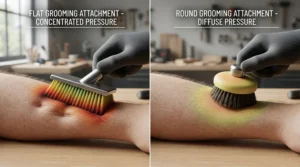
No manufacturer publishes a neat “skin contact area” figure, so this is reasoning, not a lab result. Think of total skin stress as footprint times pressure times number of passes.
Foil heads have a larger, flatter footprint, but the screen separates blade from skin, and well-designed foils aim to finish in fewer passes. One buyer’s guide argues the Series 9 PRO+ is built for exactly that: fewer passes, less foil-to-skin contact. Rotary heads flex independently, so you aren’t pressing the whole head into your face at once, and the i9000 Prestige Ultra adds a pressure warning on top.
The takeaway is practical. A smaller or bigger footprint matters less than how lightly you touch and how many times you cross the same patch. Hold the shaver like a pen, not a hammer. Let the head glide. If you find yourself pressing, the shaver is the wrong tool or the technique needs a reset.
Foil and Rotary Shaver Comparison for Beginners
If you’re coming from a cartridge razor, foil’s straight strokes will feel familiar, which is a quiet advantage for first-timers. If you only shave every three or four days, or you want something quieter and cheaper, a rotary like Shaver 3600 is a reasonable start.
Beginner rules worth tattooing on your mirror:
- Start with short stubble and light pressure.
- Give any new shaver several shaves before judging it. Skin often needs an adjustment period.
- Pick one method and stick with it for a couple of weeks before switching.
- Choose forgiving, not fancy. Series 7 or F5-5800 is plenty.
Beginners usually fail by pressing hard to chase the closeness they remember from blades. Electric shaving rewards patience, not force.
Foil vs Rotary Electric Shaver vs Traditional Razors for Sensitive Skin
| Option | Skin-friction profile | Upkeep | Best For |
|---|---|---|---|
| Foil (e.g., Series 9 PRO+) | Fewer, straighter passes | Foil and blade replacement | Bump-prone, daily shavers |
| Rotary (e.g., i9000 Prestige Ultra) | Flexing heads, circular motion | Heads last longer per reviewers | Contoured faces, less frequent shaving |
| Cartridge razor | Direct blade contact | Constant cartridge buying | Occasional close finish with prep |
| Beard trimmer at lowest setting | Leaves hair slightly longer | Minimal | Chronic ingrown-hair sufferers |
The table shows a spectrum from “closest” to “gentlest.” Electric shavers sit in the middle: kinder than blades, closer than trimmers. If your ingrowns are severe, a trimmer at its lowest setting is worth considering, since leaving hair a little longer avoids the sharp tips that curl back into skin.
Practical Guide: Your First 30 Days With a New Shaver
Week 1: set the baseline. Wash your face, dry it completely unless you’re using a wet/dry model with gel, and keep skin relaxed rather than stretched. Do the most sensitive areas first while the shaver is cool. Clean it after every shave, since buildup can add to irritation.
Week 2: dial in technique. For foil, use short straight strokes. For rotary, use light circular motions without pressing. If you’re bump-prone, go with the grain in a single pass.
Week 3: tune frequency. If your skin looks angry, add a day between shaves. If it’s calm, try your normal schedule.
Week 4: audit. Is closeness dropping or irritation rising? Worn heads or foils are a common culprit, and many manufacturers recommend periodic replacement. Philips, for instance, suggests every 12 months for the Shaver 3600.
Common first-month mistakes: switching shavers too early, applying heavy aftershave alcohol, shaving over active bumps, and forgetting cleaning day.
Real-World Scenarios: Matching Shaver to Skin
These are illustrative composite profiles, not real customers.
The commuter with neck bumps. Shaves daily, gets ingrowns along the jaw and neck, budget around $200. A Series 7, with-the-grain strokes and slightly longer stubble is the logical start. If bumps persist, a trimmer on its lowest setting is the backup plan.
The weekend shaver with a contoured face. Shaves every three or four days, hates noise, has no major bumps. A Shaver 3600 or, with more budget, the i9000 Prestige Ultra fits. The longer growth between shaves plays to rotary’s strengths.
The budget tester. Unsure whether foil suits their skin, wants minimal risk. The F5-5800 costs little and the corded option is a safety net. If it works, upgrade later.
Long-Term Cost and Maintenance: What You’ll Really Spend
Sticker price is only chapter one. Foil shavers need replacement foils and blades, and a specialist reviewer notes that rotary heads tend to last longer than foil cutters, lowering ownership cost. The Shaver 3600 at around $65 plus annual head replacement may cost less over five years than a premium foil with pricey parts.
Warranty and build quality also shift the math. The i9000 Prestige Ultra is reported with a long warranty, the Series 8 is designed to last about seven years, and the Series 9 PRO+ carries a multi-year warranty depending on region. A cleaning station adds convenience but also cartridges. Budget models skip the station, so a quick rinse and brush become your routine.
The value question: if irritation is costing you comfort every morning, a better shaver is cheap insurance.
Common Mistakes When Buying for Sensitive Skin
- Buying by blade count. Floating ability and technique matter more.
- Chasing maximum closeness. The closest cut is exactly what feeds ingrown hairs for some people.
- Assuming premium means gentle. Technique and head choice still decide.
- Ignoring wet/dry. Gel use is a major comfort lever.
- Skipping replacements. A tired head drags and irritates.
- Switching types too quickly. Give any shaver time before concluding it’s wrong.
Safety Guide: Razor Burn, Razor Bumps and When to Stop
Razor burn is immediate irritation: redness and sting soon after shaving. Razor bumps are different. Pseudofolliculitis barbae happens when shaved hair re-enters the skin, triggering inflammation and bumps. Trimming at the lowest setting is a recognized alternative to close shaving, and avoiding shaving altogether for several weeks lets most lesions settle.
If bumps spread, crust or become painful, see a clinician, since infection and scarring are possible. Electric shaving reduces risk but doesn’t erase it, and picking or squeezing bumps makes everything worse.

FAQ
❓ Is a foil or rotary shaver better for acne-prone skin?
❓ Can I use shaving gel with an electric shaver?
❓ Should I shave with or against the grain?
❓ How often should I replace shaver heads?
❓ Can an electric shaver still cause razor bumps?
Conclusion
So, who wins the foil vs rotary electric shaver for sensitive skin debate? For most irritation-prone faces, foil is the safer default, and Braun Series 9 PRO+ is the best premium example, with Series 7 as the smart value pick. Rotary earns its place when your face is full of curves, you shave less often, or you want pressure coaching from the i9000 Prestige Ultra or an affordable start with the Shaver 3600. Panasonic’s Arc5 is the wet-shaver’s choice, Series 8 is the middle path, and the F5-5800 is the low-risk experiment.
Remember what matters most: floating cutters, a light touch, a sensible circular vs straight shaving pattern, and honest attention to how your skin reacts. No ranking beats your own face as a test lab. Start gentle, give it a few weeks, and adjust.
Recommended for You
- Foil Shaver for Men with Coarse Beard: 7 Best Picks (2026)
- Electric Shaver for Seniors with Arthritic Hands: 7 Best Picks 2026
- Electric Razor for Ingrown Hairs on Neck: 7 Proven Picks 2026
Disclaimer: This article contains affiliate links. As an Amazon Associate, I earn from qualifying purchases. If you purchase products through these links, we may earn a small commission at no additional cost to you.
✨ Found this helpful? Share it with your friends! 💬🤗
